


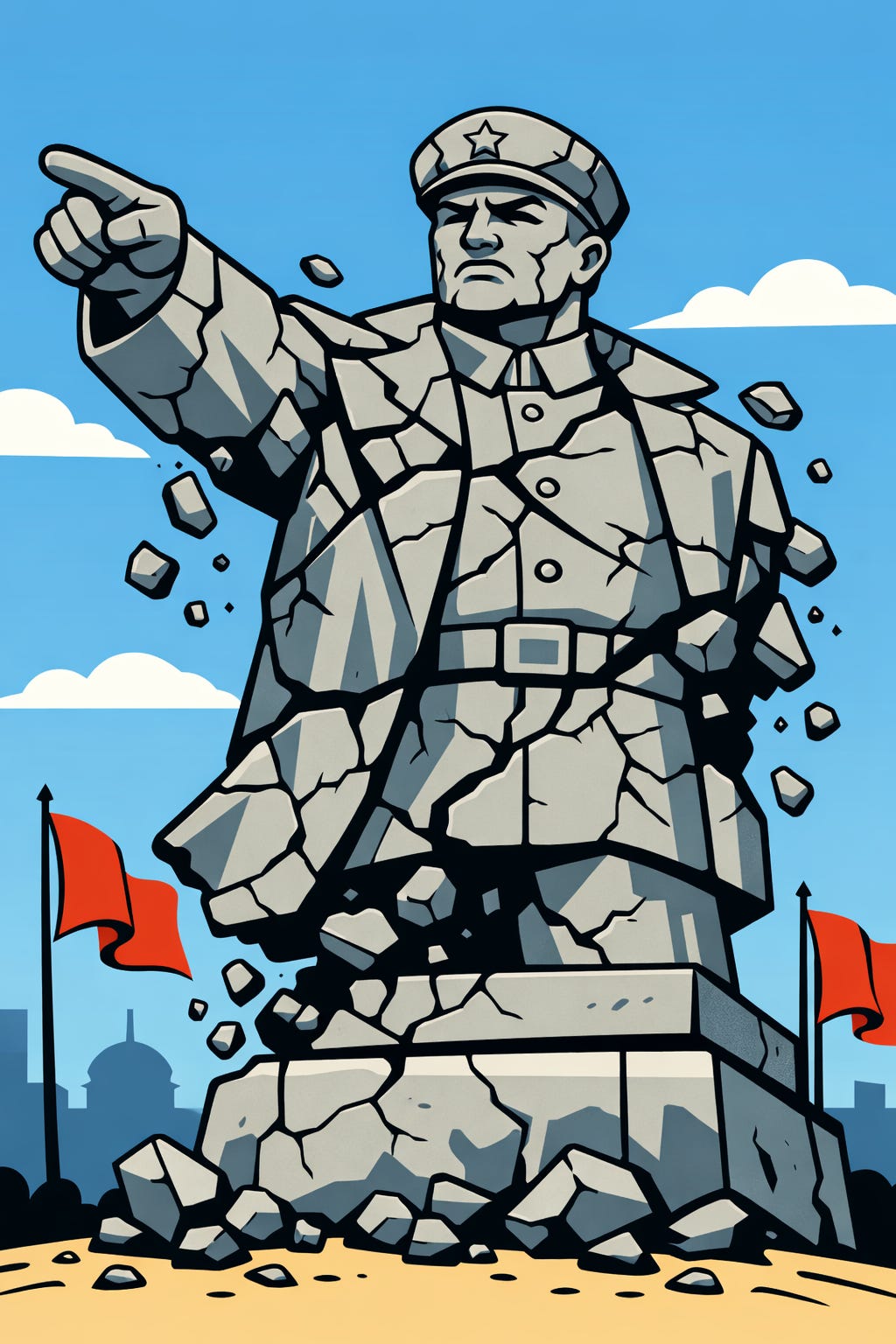
Anti-government protests have flared up in Iran.
The regime has responded with brutality. The death toll is estimated to be at least 3000. Many more Iranians have been arrested.
The supreme leader, Khamenei, showed little regard for his people. He met their demonstrations with force.
Leaders of a certain type never acknowledge their wrongdoings - but why is that?
It is a puzzle.
Iran’s regime claims a divine mandate. Yet, it falls short by most metrics. Little services, security, or freedom.
As a consequence, the public has lost trust.
This pattern of incompetence reemerges all over the world:
The more ideologically rigid a regime, the more incapable it often is. Those who believe themselves to be morally perfect do not allow for contradiction. Hence, they cannot learn from their mistakes.
Corrective feedback is no longer absorbed. As a result, dogma triumphs over evidence.
Authoritarians cannot adapt to the challenges of reality.
A perpetually certain person is blind.
He processes information differently.
If you imagine yourself to be a divine ruler, you assume everyone opposing you is a heretic - in the case of Iran, literally. This makes it easy to dismiss criticism. Those who question the ayatollah, for example, are branded traitors to holy providence.
The supreme leader does not need to listen. He needs to be listened to.
Dissent is therefore useless to him.
Advice is best punished. Protests are best criminalized. Failure, since it should not exist, is denied - swept under the rug.
Since the authorities have no learning ability (it would require self-examination), incompetence persists and compounds.
Totalitarians double down on the catastrophes they inflict.
Good policy is adaptive. It adapts to what society demands. This requires acknowledging mistakes.
But totalitarians cannot do that. They therefore (try to) adapt reality to their own wishes.
Since all humans are bound to make mistakes, they must mask their failures as successes.
The reason for this deceit is self-preservation.
The rule of the tyrant persists so long as enough of his subjects believe him to be just. His identity, therefore, fuses with the ideology that justifies his rule. He wears it like a suit of armor.
False certainty, in his case, is a survival tool.
Liberal democracies operate from an opposite principle.
No one possesses the whole truth, which means power must be spread among individuals. Through free debate (between equal peers), all perspectives are given a chance. Through elections, administrations must correct themselves - or be corrected by the next.
If leaders prove unfit to rule, the system does not collapse. New ones are chosen.
Liberalism embraces corrective feedback; totalitarianism quells it.
In free societies, governments derive their legitimacy from the consent and well-being of the governed. They understand that policy is never perfect. Instead, it must be tailored to meet the needs of the people.
This approach is resilient to changing circumstances.
False certainty breaks under changing circumstances.
Liberal systems preserve flexibility by cherishing doubt. Totalitarians do not allow for that ability. Due to their rigidity, they are doomed to fail at governance.
This is how the Iranian regime has alienated itself from its people.
Good rulers find the courage to admit wrongdoing.
Inflexibility kills good policy. It must be countered by deliberate doubt. Governance thrives not on certainty, but on a disciplined embrace of ever-changing circumstances.
Even the ayatollah will prove to be wrong - someday, or perhaps very soon.