


Marianne Williamson, an author, once wrote:
“Our deepest fear is not that we are inadequate. Our deepest fear is that we are powerful beyond measure. It is our light, not our darkness, that most frightens us. […]”
In those words, she captured a universal feeling. It can be scary to become who you are.
And it can be even scarier to live up to your full potential.
There lies a temptation in staying small and unremarkable.
Human beings are social animals. We negotiate our identities with those around us. Standing out carries a real danger.
Just wearing the wrong backpack to high school may cause social ostracism. People, unfortunately, can be mean like that.
Groups stabilize themselves by punishing outliers - sometimes for the worse.
If you choose to live out who you are without compromise, it becomes harder to negotiate your relationship to the group.
Your position within it will change, possibly for the worse. There will be friction. Others may gang up on you.
Staying where you are is a way to appease others instead.
But aside from the social dimension, there is a personal one.
When you own up to your full potential, failure becomes all the more painful. If you try with all you have and still fail, there are no excuses left. That can be brutal.
Failure, if it comes, feels total.
Your self-image changes too.
Once you acknowledge your true nature, you acknowledge a duty to live up to it. That is a burden. Something some spend a lifetime wrestling with.
Suddenly, you notice this life you live has stakes.
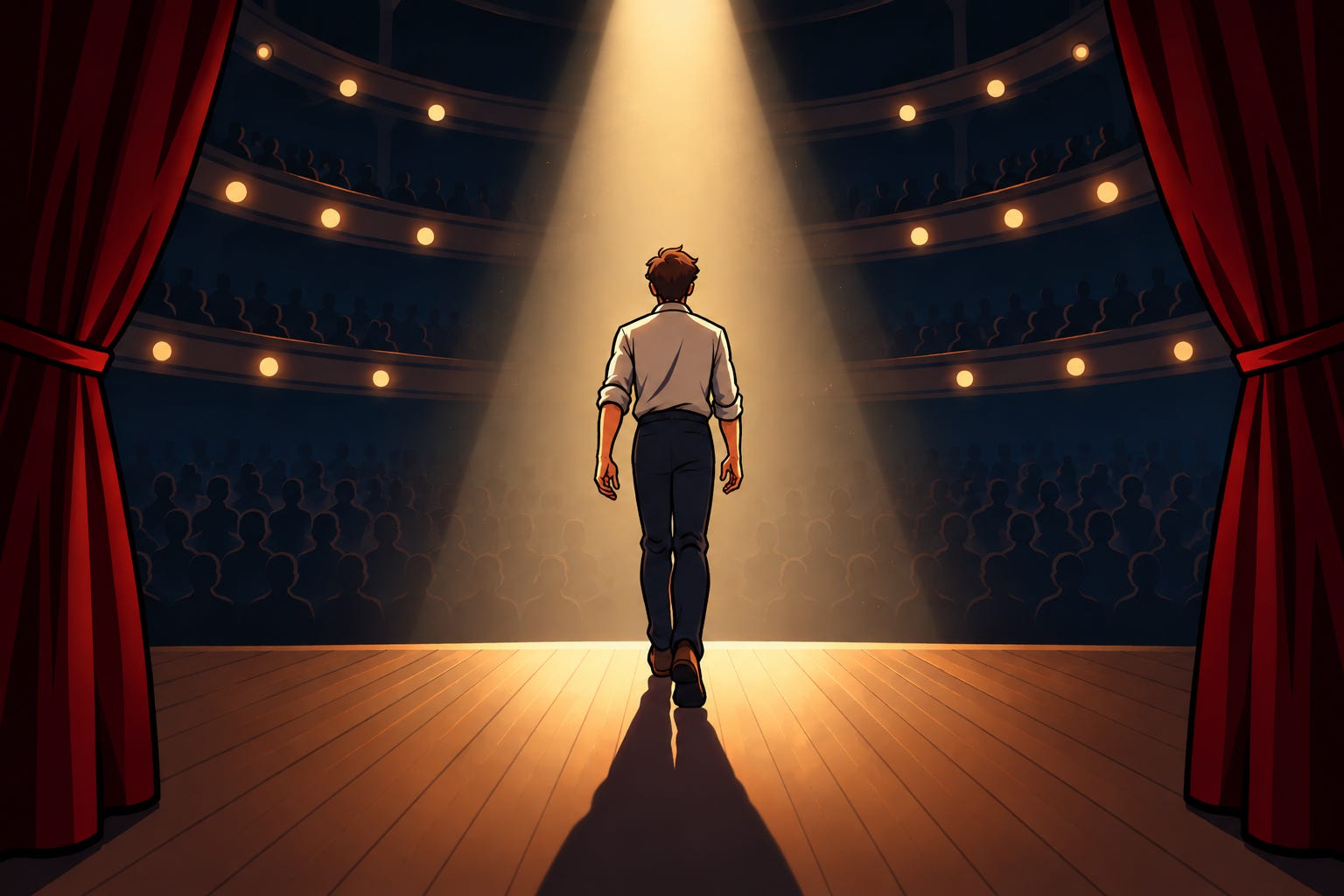
You are like a performer entering his stage.
Before entry, he is merely preparing. There is time for strategy, rumination, and anticipation. But once he appears, he must fully embody the role.
There is no longer time for doubt.
The moment you choose to live up to who you are is the same.
Instead of a role, you will have to inhabit all of you. You must own and offer your talents to the world without reservation. If life were a game, this would be called going all in.
True retreat, thus, is no longer an option.
By owning up to your full capacity, you imply something important.
You affirm that your true self, your essence, has a legitimate place in this world. That it is something worth following. There is an existential component to it.
In a way, it involves a leap of faith.
When you are born, nothing necessarily proves that you belong here. There is only the mere fact of your existence. Whether you own up to it is your decision.
It is a kind of spiritual choice. Not something you can verify as correct or not.
To own up to who you are, you must believe doing so is worth something.
It requires faith that the world is not inherently a bad place. That it, at least to a degree, may allow for itself to be changed for the better. That what you offer might be of value to others.
Hence, the fear of stepping into your full capacity is bound to a nihilistic dread.
So long as you have not confirmed the opposite, it could be true that all efforts are in vain. That life has no meaning. That nothing you could do might inflict positive change.
So long as we do not see it disproven, a kind of fear - that no good may oppose the bad - lingers within us.
Countering this fear, at least in part, is what religion is used for.
Religions organize themselves around spiritual issues. And they provide narratives that underwrite meaning-making. In their absence, the individual must sustain belief in the good without external support.
They must believe, independently, that they themselves carry an innate meaning that is real and worth realizing.
The life of a conscious creature depends on some version of such faith. Because without it, there is no stable reason to continue existing. If you are to be of use, you must hold that you are here to achieve something.
And even that still leaves the task of identifying what it is.
Although Williamson’s line was apt, it missed something.
Our deepest fear is not inadequacy, nor power itself. It is the fear that accompanies going all in. The possibility that, even when equipped with our full potential, we might still miss the mark.
Until we prevail, a fear that there is no hope echoes through the ether. The void screams that even the best version of ourselves, in all its glory, may not overcome the odds.
If we were to come at life with all we have, do everything right, yet still fail, then that would prove it all to be futile.
True success, then, implies having passed through this ordeal. To confront our deepest fear and not be undone by it. Fundamentally, it is about resisting the pull of hopelessness.
To believe that there is a righteous path in this world and walk it.
A more technical formulation would be:
Our deepest fear is not that we are inadequate. It is that even if powerful beyond measure, we will fall short. That the world will not budge; our best efforts will prove in vain.
Our light most frightens us because in the end, it forces us to challenge the dark.
This is why it is tempting to stay small.
The one who stays where he is, never trying, will not discover whether their fullest offering would have moved the world. But the one who meets life’s challenges head-on accepts a different burden. Until they prevail, they are forced to live in fear that even the best they have may fail to stick.
The latter is more acutely daunting, and therefore harder to deal with.
But once you express all you have to offer, you will find solace therein.
As you put what you have forward into the world, it will prove to you that success is within reach. Pay attention, and it will bring the peace you were looking for. If you still have doubts, it just means you still have something to offer.
Faith, strangely, proves its own worth.