


One might say the word love is overused.
It makes you wonder if all things we call love even have something in common. Maybe they all branch from a single root: some universal definition. Or maybe we are just careless with our language.
Either way, it is worth understanding the term.
In everyday speech, we claim to love a lot.
Love exists between friends, family, and lovers. We may even love non-people: a craft, a profession, an object... Someone who claims to love woodwork could very well mean it.
Thus, it is somewhat challenging to find a common denominator.
But it does seem that wherever love shows, there is attachment.
What we love, we are to some degree connected to - or at least involved with. You cannot empathize with a new car. But you can obsess over it: keep it in mind at all times.
People may say they love their new routine, or how the light hits their garden. This may not reach the depth of romantic love, but such expressions still deserve to be taken seriously.
Although the strength of love varies, it all involves some form of positive attachment.
Attachment alone, however, does not suffice.
Some of life’s ugliest phenomena are born through attachment. Hatred is attachment-based. Without fixation on an object, it evaporates.
Hate needs a target. For the hater, detachment is virtually impossible - like a rabid dog with a bone.
Thus, the quality of the attachment matters as much as the attachment itself.
Love is different because it is oriented towards the good of whatever it directs itself towards. It wants its object to persist, even thrive. Hatred, on the other hand, wants its object to suffer and be undone.
Connection comes in many forms.
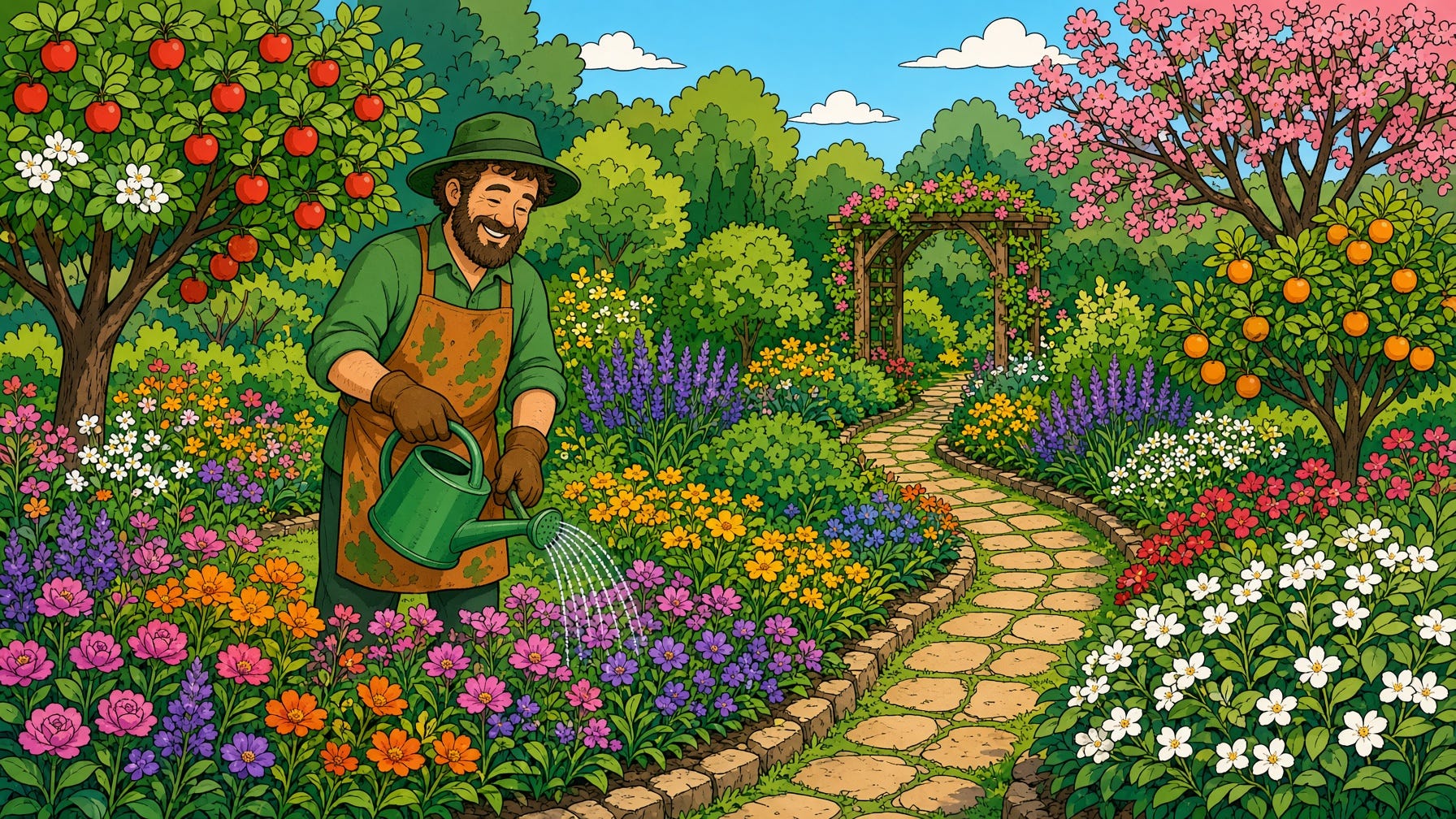
Love wants to make things bloom.
When you express your love for something, you imply its well-being is of your concern. As long as the latter is remotely true, your statement of love is honest. The degree matters, but not for accuracy’s sake.
For the love of persons, this easily makes sense. For the love of non-persons, it is slightly more complex (but still coherent).
The following example will aid in illustration.
The woodworker who loves his craft has spent much time honing it. Perhaps he carves a masterpiece: something he is infinitely proud of and wants to have around. Into this object, he has channeled a love for his craft.
The masterpiece remains inanimate. Yet, it is a testament to his love: both of the woodwork and his dedication to the particular object it produced.
Even though it was not a person, he wanted to see it prosper.
If you tell a stranger “I wish you well”, even if fleeting, that is an expression of love. It is almost trivial, but still honest appreciation. So even the most inconsequential uses of the word can be read as truthful reports.
Love, it seems, lies at the root of a great deal of things.
It is the mother of growth.
Unsurprisingly, maternal love is often referred to as the most potent example of it. A good mother only wants her children to thrive. Through her affection, she nourishes them as they grow into adults. Herein, love translates into the formation of quality human beings.
There is little distance between motherly love and the mother of love.
And as they say, love is a verb.
It has an active character. Love is the act of giving to an object with its welfare in mind. Metaphorically, it breathes life into whatever it touches.
In its purest form, that is a selfless affair.
So attachment is not the essence, but the vehicle.
Wishing anything well requires some minimal attention to it. That is no different than temporary attachment. Attachment may fade while the provided love does not.
At the core, it is about feeding well-being.
You can give and take love, but once you demand or insist on it, you are in the wrong.
Love is, ideally, altruistic. To love someone, you must respect them first. And if you bypass their volition, it is impossible that you do.
Lose respect, and you lose love.
Love has its roots.
It varies deeply in intensity, but at the core it appears the same. It is a gift towards something you wish to see prosper. It is how you wish things well without demanding a return.
It is always simple, yet never easy.