


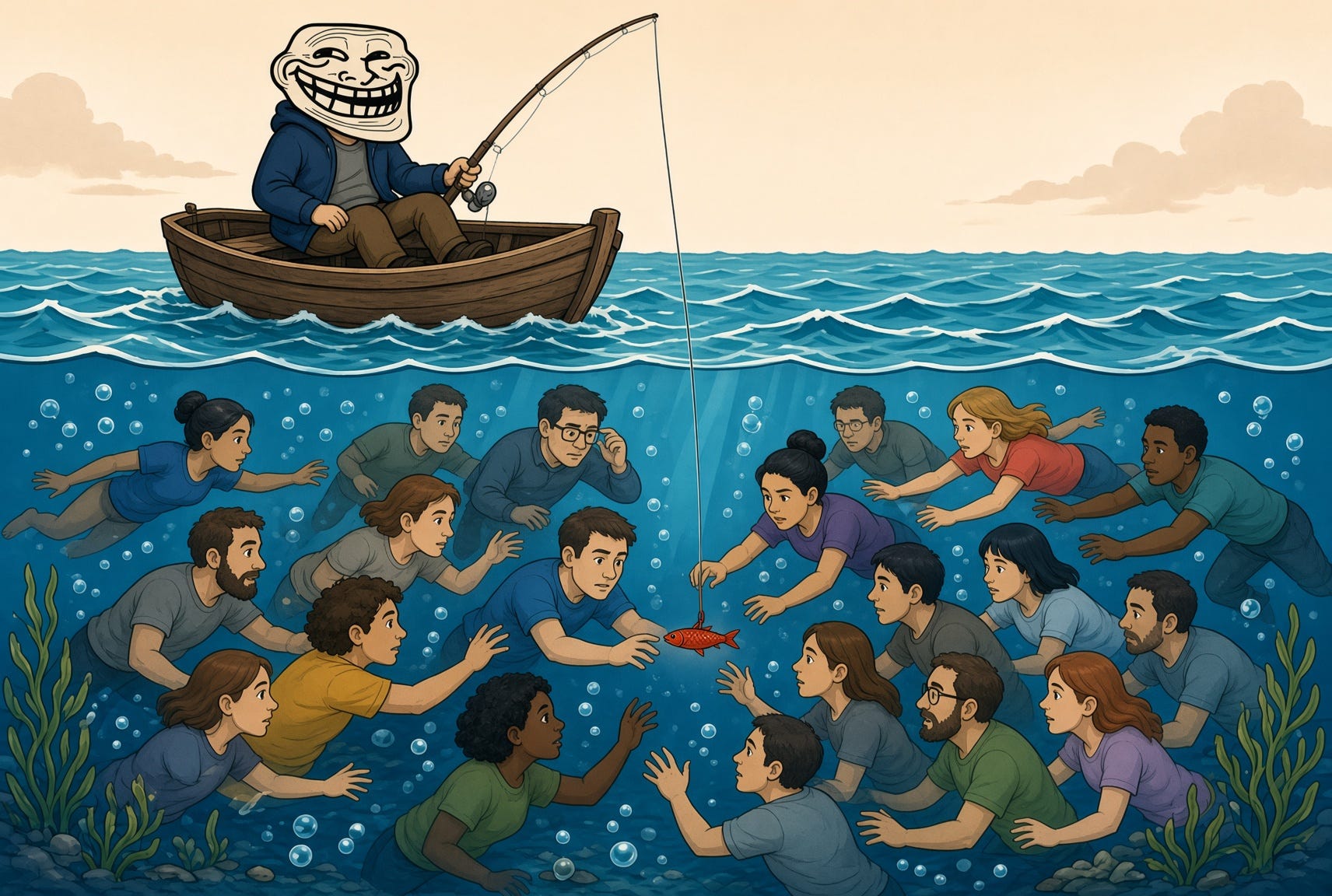
Trolling is a funny word.
We use it for friendly roasting, but also for coordinated cruelty. Clearly, it applies to a broad spectrum of behavior. Cutting jokes can have real value, but pointless triggering less so.
How do we distinguish between the two?
We can start by defining trolling.
Some people who call themselves trolls may actually be worth listening to. They are performing a form of satire: lampooning overly serious people. Simultaneously, some of them are truly acting in bad faith.
There are trolls whose sole drive is to bring misery to others. Even some self-proclaimed satirists are just trolls with a large audience and institutional legitimacy.
Titles are not enough to determine which is which.
Trolling, at its heart, is not just innocent teasing.
It is typically an act of provocation. The goal of the troll is to elicit a reaction through irritation. He is an emotional manipulator.
The target’s rage makes him look bad and also keeps him engaged. That is exactly what the troll wants.
The victim, hooked in, grows increasingly exhausted.
The troll often does not even mean what he says.
Only the target has to. So long as he is offended, the troll has achieved his aim. The target then loses composure.
He is usually operating in better faith than the troll. As a result, he takes the trolling more seriously than it is meant to be.
The good faith of the target makes him relatively gullible - and therefore vulnerable.
Because trolls are unserious, unaccountable, and often anonymous, they always have an exit strategy.
It is easy for them to fall back on something being just a joke. Repercussions stay low. The getaway remains easy.
For the target, however, the emotional cost can prove quite high.
It is a self-reinforcing trap.
Trolls study their targets and identify pressure points: chords to strike. They find whatever gets on someone’s nerves and press it repeatedly. If he chooses to engage, the target will eventually overreact.
To the troll, it is all a joke. He loses no composure.
But the target does.
As that happens, his reaction turns into new ammunition. The image of the target is now blemished, as another flaw has been exposed: sensitivity. The troll has granted more material to work with.
This way, the target gets stuck in a vicious cycle.
Jest is the troll’s main weapon.
It lowers his perceived investment and raises the target’s. The two parties might face off, but it is always an unfair game. The target is often sincere, but to the troll it is all a big joke.
He provokes, exits, then repeats.
Trolls and satirists are not the same.
This is worth mentioning.
The two can seem similar at first. Satire, however, has value. Sometimes, people in positions of power should be checked; their absurdity should be lampooned.
Both have hints of ruthlessness. But the difference lies in accountability.
A true satirist will always stand behind his jokes; a troll will not.
Satirists play a public truth-game: their jokes bring real problems to light. Typically, they criticize bad-faith actors. And when pressed, the satirist answers for what he puts out in the world.
As a result of their work, the bigger picture is clarified, not muddied.
Trolls do the opposite.
They press buttons for the sake of pressing buttons, and muddy the waters. While satire pressures bad-faith actors into good-faith behaviour, trolling achieves the opposite. It tempts good-faith actors into bad-faith behaviour: self-righteousness, tantrums, and even calls for censorship.
Satire punishes phoniness, but trolling punishes sincerity.
To discern the two, a few characteristics are relevant:
The satirist defends what he puts forth; the troll does not. The satirist gives his target a fair hearing if they respond in good faith; the troll does not. The satirist intends to highlight the truth; the troll intends to provoke a reaction.
These are important factors.
The social effect of trolling is corrosive.
It is toxic culturally. The most influential trolls on the internet do not just turn emotional pain into entertainment. They make a living doing so, drawing clicks, clout, and currency.
As it becomes normalized, trolling can become deeply unhealthy to society.
To trolls, sincerity merely provides an opportunity for mockery.
They erode the breathing room good-faith actors have in public discourse. Great satirists, by contrast, own their jokes. They target frauds, not anyone who bites.
A healthy discourse lampoons phoniness, not honest intentions. Sadly, if it were up to the trolls, the latter would be viewed entirely as cringe.
Going down that road is a slippery slope. If no space is left for the earnest, no space is left for the honest.
And without honesty, there can be no honest standard: nothing to live by.