


Sometimes, we are on the right path, but it is impossible to see it.
Essentially, we are moving forward on faith. Progress is being made, but something is blinding us to the arrival itself. Until the result becomes visible, we can only persist and do our duties.
It takes discipline to keep going regardless.
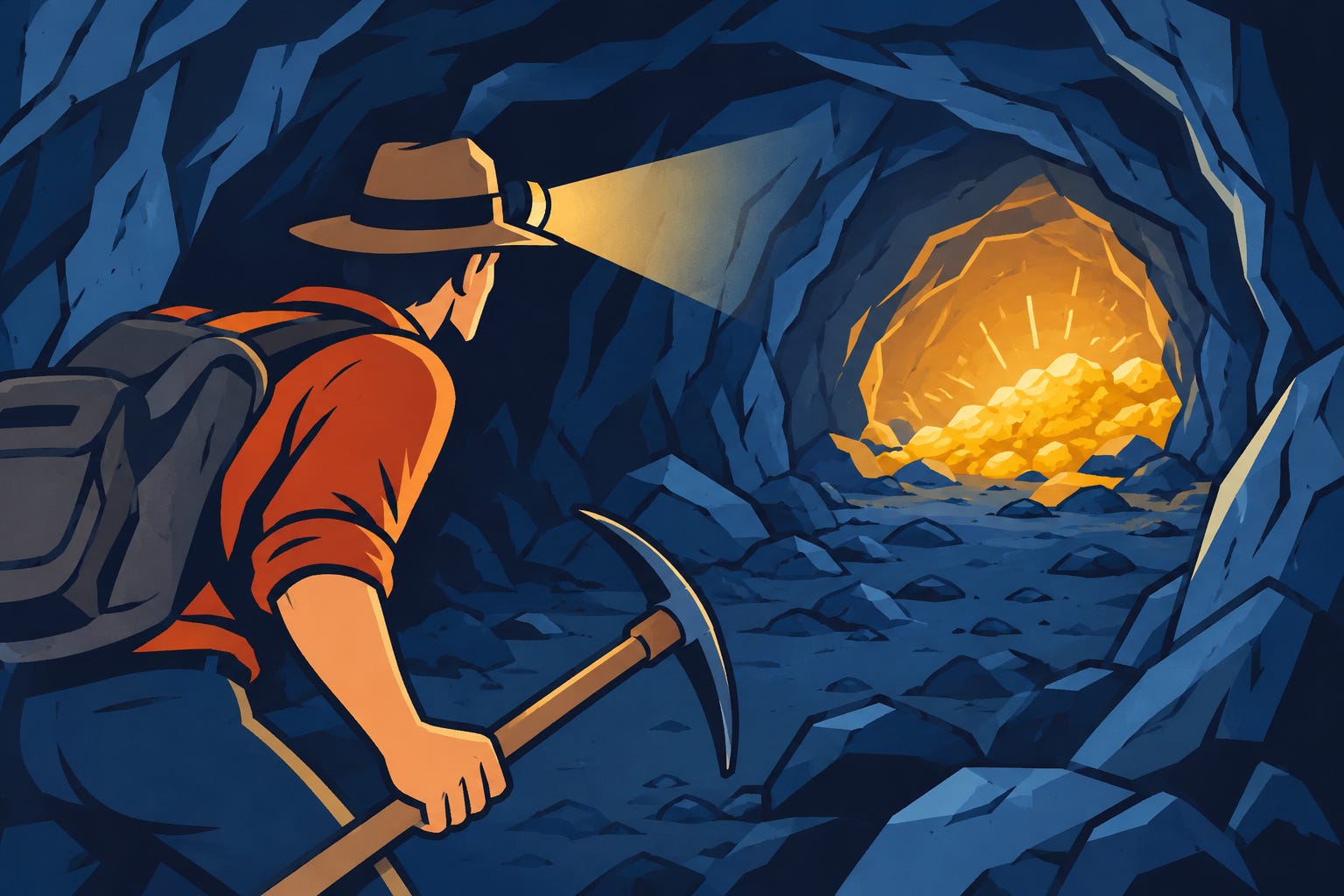
Imagine you are mining for gold.
You might spend years in the dark. You have your coordinates, and no reason to distrust them. In fact, you trust their correctness fully.
Still, until you find the gold, you do not see it. You can only hope, quietly, that you are on your way.
That is where faith is useful.
The same is true of life.
A book may be almost finished; a disease almost cured; a home almost built. But in none of the three does the success feel tangible until the job is done. Although good work and success are linked, they feel distinct.
That is because you experience them at different moments.
But both have their uses.
If you are still working, it is often better to focus on how you are not there yet. It keeps you sharp: intolerant of mistakes. If you focus too much on the progress already made, it could make you lazy: content with the work delivered.
It is good to be critical of yourself, at least to a degree.
The miner who is truly devoted to getting the gold exercises a kind of self-control.
To work towards it, he withholds himself from desiring it. Perhaps he is on the correct path. But he does not mistake having been correct so far for having already arrived.
When he gets there, he gets there.
This is how he preserves his mindset.
The miner does not lose his edge so long as he still needs it. His mind is still optimizing for the result, so the experience of success itself trails behind. If he believed the gold was secure already, his journey towards it would be likelier to fail.
To get what he wants, he better not assume he will.
It is unwise to praise the day before sunset.
That is what the proverb says.
Similarly, you should not celebrate before finishing a task. As long as the victory is not guaranteed, unwinding is a liability. For now, it is better to withhold the feeling of victory.
It keeps one from slacking.
Faith, here, is what keeps you going when you have not yet arrived. Even if you believe the map you drew, maybe you do not yet inhabit the place it points toward. But if you have checked them well, you must hold on to the belief that your coordinates are right.
It allows you to move forward.
What you do not pay attention to leaves you temporarily blind.
If you are the miner, you are typically not failing to see; you are refusing to. So long as there is still work to be done, it is better to focus on the task ahead. Failing to do so would justify a premature unwinding.
What is already done is done; so it is better to attend to the work that remains.
This makes you know you are on the right path without feeling it.
Abstractly, you may be aware that you are moving in the right direction. But that does not mean you are experiencing it fully. Often, that is because the feeling of achievement rivals the quality of the work.
If you are still reaping rewards, you cannot be solving problems.
There is another pragmatic reason.
Your progress should not be undone.
A dragon that is not fully slain may recover and avenge itself. Even if you have walked a correct path for long, that still does not imply the result is secure. You must follow through to attain it.
Even if you have been grappling with it forever, an unsolved problem remains unsolved.
No threats should remain when you ring the victory bell.
When a job is entirely done, it will naturally become evident that no further problems remain. A battle ends once the enemy stops raining down arrows. A building is finished once the weather no longer knocks it down.
Success typically does not announce itself with trumpet sounds. Instead, it just becomes evident there are no more ordeals to manage.
Suddenly, you cannot find a reason not to unwind.
But as you have gotten used to the work, caution often remains. It can be hard to admit things cannot fail anymore. So unwinding begins slowly.
As relief settles in, the fog clears, slowly.
But sometimes, the fog has become the climate you live in.
When the work has only begun, it is good to stay focused. But over years of endurance, it can compound into all the person knows. The strain becomes ingrained.
Numbness, while you work, can become the default setting.
It has its downsides. The mist may have become your world. And that explains the reluctance to unwind.
Leaving it is like stepping into a new universe.
But it is good to discern between a live dragon and a ghost.
Actual problems do require effort. But if there are none, there are no actionable steps to take. You must let go and rest.
You can ask yourself if anything might still undo the result. If so, you should keep going.
If not, you are done - for now.
Refusing to acknowledge arrival is, somehow, how we arrive.
It is how we enforce correct work. And the work gets us closer to where we want to be. Still, doing so requires faith: that if you take the right steps, you will end up where you should.
So long as you are not there yet, you may as well ignore how far you have come. And once you are there, your environment will tell you anyway.
Slowly but surely, you will acknowledge it; not because you need to, but because there is nothing else to do.