


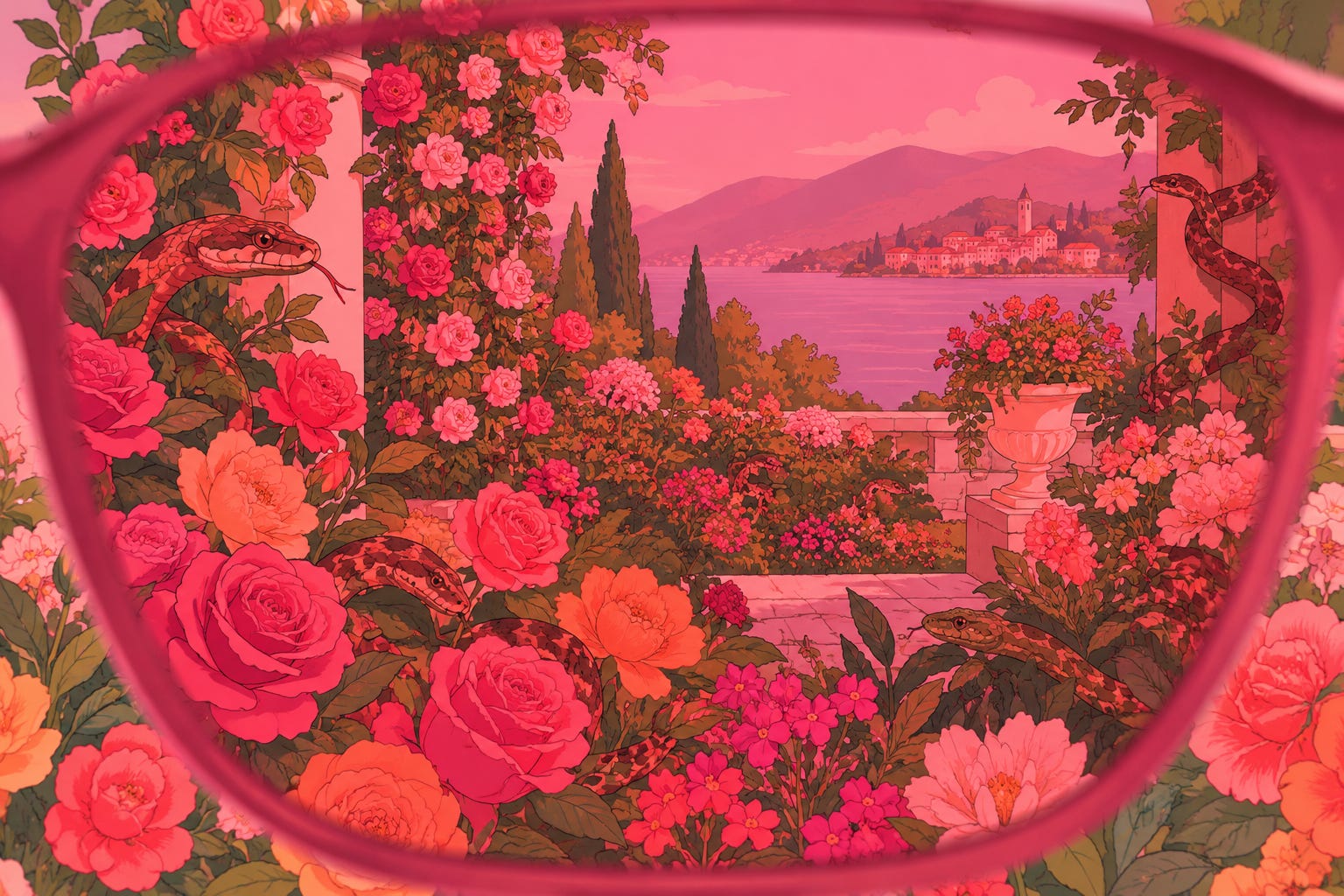
Romance can mark the start of a life worth living.
When navigated well, it may lead to connection, intimacy, and even a family. At the same time, its bliss can blind us to red flags. The pretty picture we fall for may very well fall apart.
The beginning feels pure, and often is. But it could end in catastrophe.
How can something so positive end poorly so often?
Some claim family is at the center of society itself.
If that is true, then romance is its genesis, since it often comes before family formation. But even if it is that vital to human existence, it is also a dangerous affair. Loving a person makes it easy to overlook their flaws and ignore the dangers ahead.
A relationship that felt immaculate can turn into something hideous. And the worst betrayals ruin people in a day.
Romance, thus, is a thing of extremes; it goes either way.
Idealization explains why.
In the early stages of romance, we do not just notice each other’s positive features. We enlarge them. This can be appropriate, but also unhelpful.
It is good to encourages positive traits, since it helps someone grow virtues that are not there yet. But it is bad to just assume the virtues are already there.
You should not expect anything you do not know about your romantic interest to be, by default, as awesome as everything else.
Seeing potential is, in itself, a good thing.
People have unused capacities. They can always become more than they currently are. Romance calls that forward through appreciation.
The risk lies in demanding that they do. The person must be willing and able to improve; if they are not, you are coercing them and kidding yourself.
It is a mistake to believe that what they could be is what they already are.
If you do, you will end up loving a portrait.
The living person, in such a scenario, diverges from who you hope they are. Then, they can only disappoint you. Feeling that someone is not who they pretended to be may even feel like a betrayal.
Roughly, there are two approaches:
If you encourage someone, you acknowledge the gap between who someone is and who they could be. That is what the encouragement serves. You want them to be the best version of themselves.
If you idealize someone, you demand perfection. That is a disservice to both them and yourself.
As you pressure them into being a certain way, you will either harm them or push them away.
Here is a useful test:
What happens when the person falls short of the image you had of them? Do you acknowledge that you were wrong? Or do you pressure them to perform to the portrait?
If you are doing the latter, you are forcing them to adhere to a selfish ideal.
As long as you are merely encouraging, you are being unselfish.
It means you want the person to become everything they could be, whether you are there or not. That is good, but it still does not protect you fully. It can still blind you to the potential risks.
Strong faith in another person can cause impatience. The present situation, then, is seen as an insult to the vision.
As you grow impatient, they may turn hostile.
The danger lies in refusal to see the negative.
Even if you do not want to witness a person’s negativity, it remains there. The darkness lingers. As it fails to meet your expectations, it can morph into resentment and come back to bite.
The result, then, may be an ambush. Not because the danger was subtle; just because you refused to see it.
If you refuse vital information because it sounds inconvenient, you will create the conditions for your own demise.
Romantic idealization, sometimes, disables our capacity for alertness. When that occurs, we ignore negative data completely. Red flags come to be framed as either non-existent or anomalies.
As the dangerous part of the picture remains unmapped, it will arrive as an upset eventually: like a predator jumping from the bushes.
Love, in all its softness, reduces self-protection.
As it lowers your guard, it makes you vulnerable. In a war, identifying threats would be synonymous with survival. But in romance, acknowledging the bad in someone may feel like a betrayal of the adventure you are on.
The purer it initially felt, the more the heart will refuse to acknowledge it when something is wrong.
So, romantic love is adaptive only part of the time.
To be healthy, it must understand what the other person could be, but also what they are not yet. Infatuation, which is only appropriate in safe environments, may occur in an unsafe one. Therein lies the danger.
Someone in love is vulnerable; someone in love with a bad person is in jeopardy.
There is a popular belief that love can overcome anything.
That is only true if combined with a ruthless realism. Blind optimism is inherently maladaptive. Staring at the sun keeps us from seeing what is to rain down soon.
Romance itself, although a powerful source of growth, does not protect against what comes to destroy it.
This is why healthy couples have teeth.
They cherish their warmth, but protect it. To do so, they must keep track of the big picture. If they do not identify problems along the way, whatever they seek to grow will not endure.
Naming the bad does not undo romance. It is the opposite: a requirement for it to endure.
Lowering your defenses is fine only once the environment has been secured.
Storms come unannounced. And belief in love alone is not enough to weather them. If you only look at the bright bits, you will not discern darkness when it comes your way.
It will hit you over the head.
The healthier approach is to acknowledge the negative when you see it.
You can always work through it. Still, it takes courage to acknowledge that something precious may end in ruin. You must prefer a harsh reality over a pleasant illusion.
But romance should not be treated as a sedative.
The creed “love conquers all” only applies if combined with ice cold problem-solving. Otherwise, it immaturely exaggerates its raw power. Like a boy who thinks he can lift a truck by sheer will.
The wish does not come from a bad place; it is just unrealistic.
Romantic love, when mature, still cherishes itself. It is simply not superstitious: believing that you can solve all of life’s problems on a vibe. Instead, it maps out the terrain thoroughly in order to advance.
That means it does the work: seeing threats, naming problems, not dropping one’s guard too early. Acknowledging positive potential rather than actuality.
Happily ever after does not start right after you first met; it begins after facing the dragons: together.
Romance ends in catastrophe because it is prone to naivety.
The positivity of the experience makes us blind to the negative that remains. It maps uncharted land as safe, while there may very well be snakes in the grass. It is healthy to dream about who a person could be, but only if you admit to yourself how they are not there yet.
To allow for each other to grow, we must be patient. It is unfair to demand it all straight away.
Demanding means taking; loving means giving.