


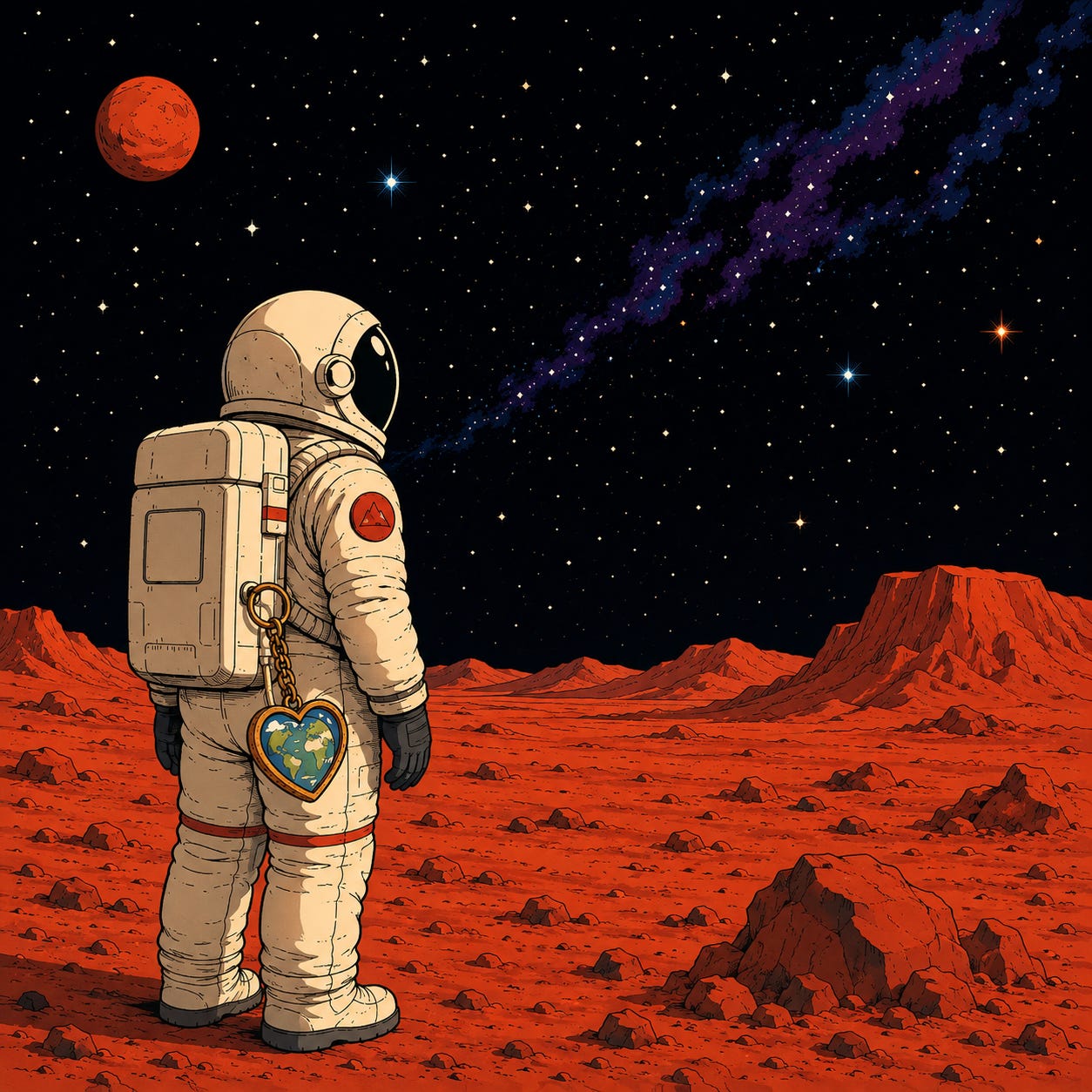
Space travel speaks to our imagination.
At the same time, it is perhaps the hardest thing ever attempted by mankind. Why are we compelled to do something so hostile to how we evolved? Humans emerged on a life-friendly planet, yet we dream of conquering the void.
Our drive to reach the stars reveals something about how we are wired.
Exploring the universe has an almost spiritual feel to it.
Space travel should not come naturally to us. We evolved entirely on Earth’s surface: an environment that, by comparison, is friendly to our species. Outer space, on the other hand, is hostile in almost every way: vacuous, extremely hot, extremely cold, and full of radiation.
Taming it would require a triumph never achieved before: an awe-inspiring technological achievement.
Still, some of us are crazy enough to want to accomplish it.
Why do humans “gravitate” to outer space?
First of all, it is fair to say we have an embedded exploratory instinct. It led our ancestors out of Africa, across oceans, and into every inhabitable niche. Leaving your tribe to start a new one, when successful, is an effective evolutionary strategy.
You can apply that to interplanetary travel. Mass extinction events occur; should they happen again, a colony on Mars would save the species.
Space travel is a way of spreading our eggs across multiple cosmic baskets.
Aside from that, it provides meaning.
Something about space is transcendental. Expanding consciousness into another realm, one not yet inhabited, may be a deep source of purpose. Anyone who participates is bound to feel like they are part of something important: something larger than themselves.
Those involved will find a sense of common destiny.
But there are darker currents underneath.
The desire to leave Earth can be ill-informed.
Sometimes, the wish to leave our planet is a form of escapism: leaving not to reach a new destination, but to escape one’s roots. Some of those involved in colonizing Mars do so because they have given up on Earth. They want to start clean elsewhere.
Their motto is not “reach for the stars”; it is “I don’t want to live on this planet anymore.”
But inhabiting a new planet will not magically solve the issues that plague us on Earth. Any society, even on Mars, will consist of human beings who bring with them the myriad of flaws inherent to our nature. Mars, with its extreme cold, thin atmosphere, and sky-high radiation, is no less difficult; it will be Earth on hard mode.
The next planets in line are far more hostile than our life-tuned home. Terraforming them will be a greater struggle than settling Earth ever could be.
We were made for this planet, so if we cannot make it work here, we are unlikely to make it work anywhere else.
The urge to venture out into space is not all cowardice.
But it certainly is not all courage.
The sword cuts both ways. It channels humanity’s highest aspirations: expanding life, following curiosity, and pushing natural boundaries. As much as that is true, it also illustrates our tendency for escapism, avoidance, and denial.
Humans are a frontier species: restless, unwilling to remain bound to the forces that cradled them, but to move forward, they must remember where they come from.
The motivations for space travel should be positive.
The colonization of other planets ought to be motivated by a love for humanity, not a desire to escape it.
As humans venture into space, they will inevitably take themselves along for the ride. All the problems we cause on our home planet, we will cause elsewhere. To keep our nature from doing us in, we will have to own it, not flee from it.
Even in outer space, humans will remain flesh and blood: Earthly creatures.