


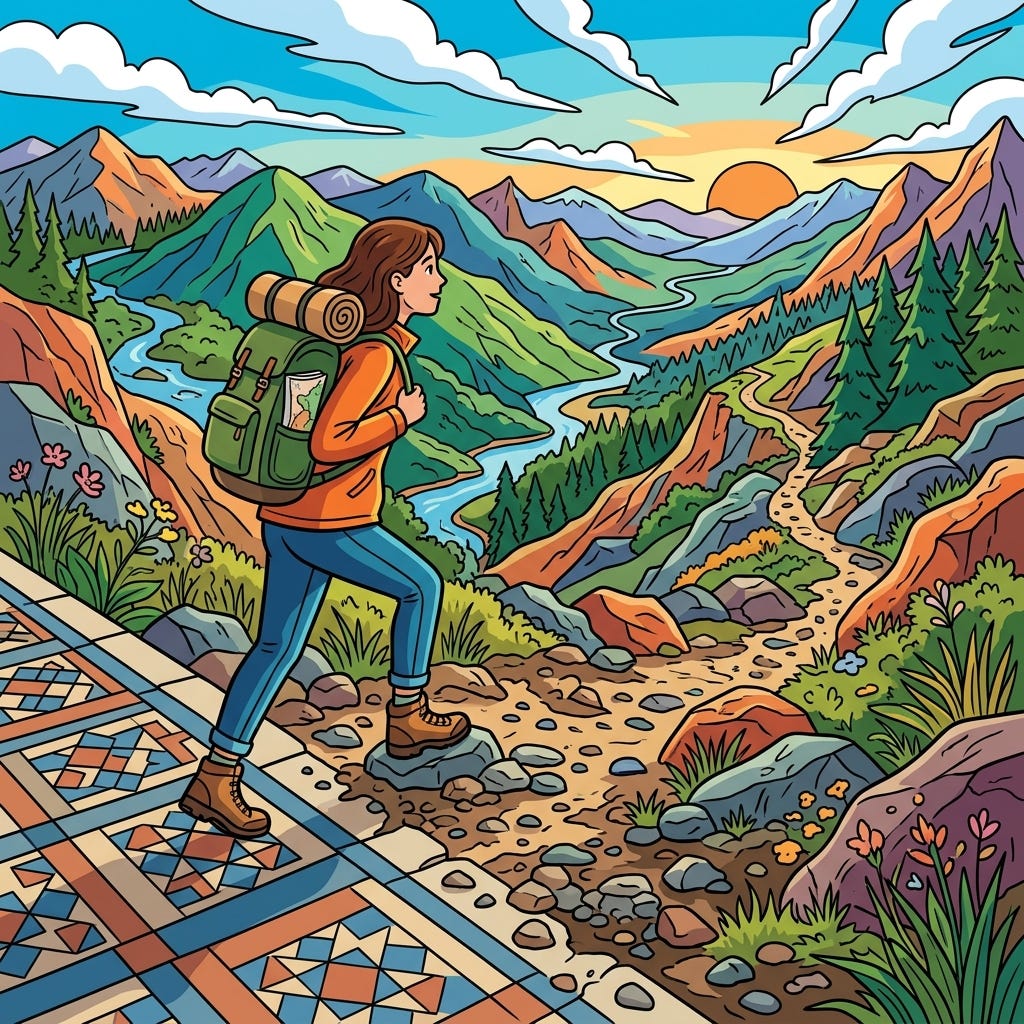
Travel might be the best way to get out of a rut.
At home, our habits can become ingrained: almost unchangeable. Travel helps you grow aware of them. Novelty, as it shocks you, hits a mental reset button.
It reconfigures how you see things in front of you.
Our habits are at the basis of how we adapt.
As we grow accustomed to them, we forget they exist: they become our mind’s furniture. This makes the familiar easily mistaken for the universal. Although our preconceptions of life do not apply anywhere, we come to think they do.
Travel is great at blowing up this illusion.
Different cultures make us reconsider how we view things, but that is not all. At the foundation, novelty challenges our habits. Forced out of our comfort zone, we are forced to deal with an environment less predictable than home.
Because we inhabit home, we know how it works. Elsewhere, it is quite the opposite.
Meeting the unfamiliar, we are forced to adapt.
Amidst the unknown, even the simplest acts begin to demand attention again. What was once called normal is revealed to be merely what we were used to. Habits are the most fundamental thing travel lays bare.
They worked where you kept them, but that does not mean they will work wherever you will be.
Challenging habits is a miraculous side-effect of novelty.
A settled life brings stability, but can cause a rut. As our habits remain functional, they lull us to sleep. As we go on adventures, we are forced to integrate the unknown into the known.
The familiar should not be misinterpreted as how the world works.
Travel, instead, produces a continuous stream of situations in which our old programming fails. If we just do what we were used to, we fail, so we have to pay attention to real time. We become forced to guess, err, and adjust.
This requires humility. If you’re not willing to look stupid, you will not learn: not about other cultures, but also not about yourself.
There are two things novelty requires of us.
One is problem-solving. As you enter the new, it will throw unique problems at you. Since your familiar toolset cannot help you, you are forced to adapt.
The other is, simply, appreciation. Because any new good thing (like beauty, joy, or bliss) stirs up an appetite for life.
Novelty surprises not only on the side of difficulty, but also on the side of plenty..
We can be stuck at home for too long.
It can come to feel as if that is the only world that exists.
Travel will demonstrate to you that there are things to appreciate beyond the familiar. That changes your relationship to where you come from. It is still yours and appreciated, but now part of a larger inventory of things to be grateful for.
The known, home, then becomes a basis from which to explore the unknown: abroad.
Travel, in this light, is a way of placing yourself where new things keep arriving: good or bad. It is how we practice a specific kind of stance. One foot is in the familiar; the other in the foreign.
Because of its dual nature, both optimism and caution are required.
As Bilbo the Hobbit put it: “You step into the Road, and if you don’t keep your feet, there is no knowing where you might be swept off to.” The unknown can be truly terrible, so there is wisdom in that.
But, equally, there is positive potential. The same step, if taken correctly, may lead to the promised land.
Both great and terrible things exist beyond the familiar.
Ruts can become dangerously tedious.
That means breaking out of them is necessary.
A rut is a repetition that has stopped teaching you. It takes from you, but no longer offers anything new. When a person gets too comfortable, their appetite for life can turn idle.
By breaking open the rut, travel brings you back in touch with yourself.
This is a worthwhile process. Predicting the world correctly is how people stay alive. A fully unchallenged life, however, may turn dangerously stagnant.
It can be difficult to snap out of.
To some, novelty even feels inherently negative. They view the foreign as inherently dangerous. Such people greet new things with contempt, as even abroad they merely recreate their home: what they are used to.
But new things, like all things, come in two forms: pleasant and problematic.
If you approach them with tact, your habits will be tested, but ultimately honed. You find out which ones were there for a reason, and which ones were just uselessly repetitive. If you were a computer, travel would be cause for a software update.
Not only does it stop you from crashing; it will help you function better. The previous versions of you may come to seem outdated by comparison.
But if you can manage it, you become more refined as a whole.
It will help you acquire a new skill set and a deeper appreciation for life. You will train yourself to no longer panic when you cross a new threshold, but adapt instead. This is how travel makes you formidable.
It is an integration tool for how you approach, experience, and appreciate the world.
By shaking up your habits, travel may change you fully.
If you do not let it scare you off, it will enrich you. Novelty thaws the rust of rest. It restores adaptive ability and reminds us of how beautiful the world can be.
If our habits do not change from time to time, they become a prison. Travel is the most immediate and efficient way to break out of it.
It is how we greet the world anew.