


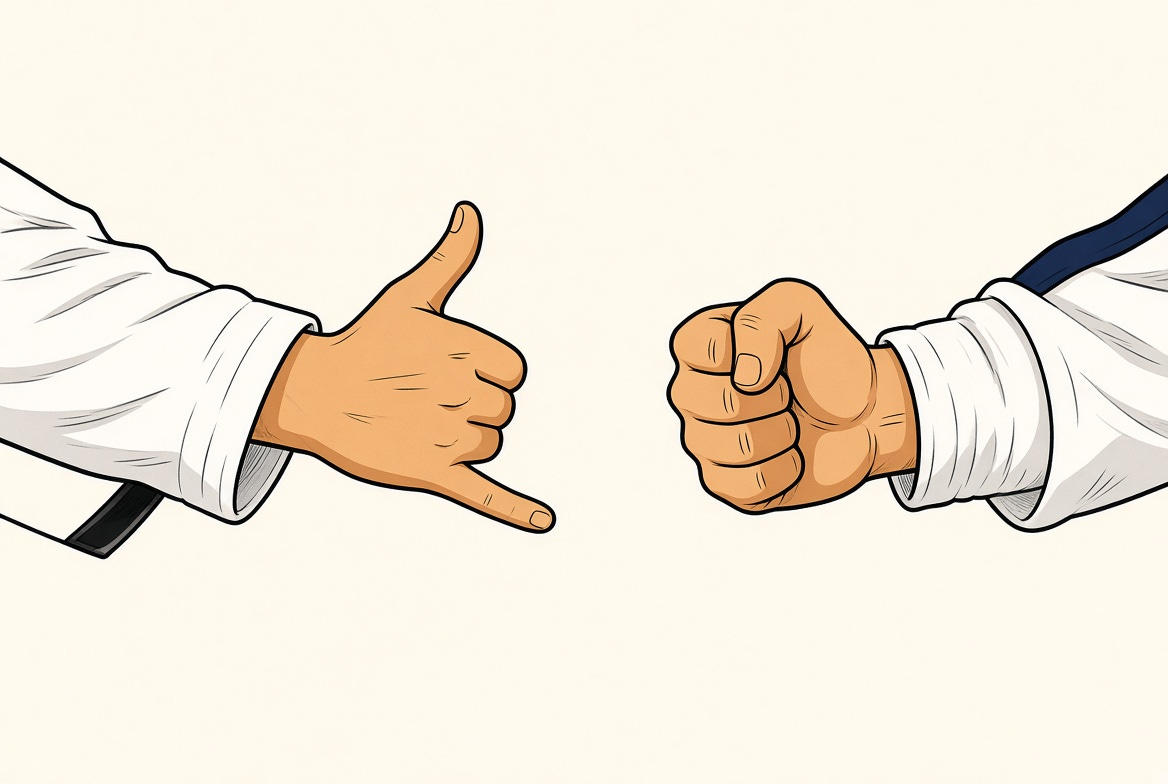
Martial arts are uncomfortable, but that is the point.
Despite its harsh nature, many practice it extensively. What is the reason for that? Apparently, it offers something ordinary exercise does not.
It is worth examining what that is.
Learning how to fight changes you.
The change is not just physical, but also mental. Contending with a resisting partner is a unique experience. It allows you to develop qualities that are hard to find elsewhere.
Those qualities deserve to be named.
One of them (perhaps the primary) is voluntary exposure to adversity.
Training puts you in a position of simulated threat. It asks you to stay there and still function. You get in uncomfortable positions for extended periods, and learn to swim in the water.
Powerlifting is no easy pursuit, but weights do not try to choke you unconscious. A Brazilian jiu-jitsu black belt will.
They are not the same.
Life itself has adversity too.
But life does not have an off-switch. If you trust your training partners, you can dial how hard it gets, and tap out when you are in danger. This allows you to dose adversity to an optimal amount.
If you learn comfort in bad positions, you will not panic inside of them. It is not about how tough you are as much as about the ability to inhabit unpleasant circumstances.
Even in the worst of places, you can work towards solutions.
The first thing is to stay calm.
This is true whenever you are in a bad spot.
Calm is a precondition to seeing through the fog of war. Pressure, pain, and panic: these things cloud your judgment. But if you allow panic to possess you, the fog will win.
It will narrow, or even obscure your vision fully. And an environment that is not registered cannot be defended against.
In the end, that is how you lose.
Calmness prevents blindness.
By refusing the storm you are in, your perception remains unclouded. As a result, you may be able to still see the way forward. The next problem remains apparent.
That begins with tranquility.
And this is the first capacity you train in martial arts, if you do it correctly. To learn how to swim, you must get used to the water. Here, water translates to the violence of life.
Ordinary exercise cannot do this for you. Weights alone, for example, pose no active threat.
An opponent does, however, even if he is your friend.
It explains why some tacticians use fear as a weapon.
Fear invokes panic. Panic clouds the mind when it needs to be clear. That gives its instiller an advantage.
If the fearmonger succeeds, his opponents start the fight impaired. His lack of understanding will provide strategic openings.
Intimidation is not an honorable tactic, but it is a tactic.
To train well, you must avoid this trap.
The more you keep calm under pressure, the more impervious you will be to fear. The danger remains real, so you must respect it. But adversity no longer recruits your nervous system as an ally.
There is a fine line between acknowledging a threat and allowing it to overwhelm you. Respecting force is good, but allowing it in is not.
Between panic and recklessness lies the ability to see things merely as they are.
This provides a crucial lesson.
Life may get negatively chaotic. But you do not have to go along with it. Whatever happens, you can make the correct decisions if your mind stays still.
If you match the disturbance, your nervous system will speed up, and your mind will lose control. Repeated exposure teaches detachment instead.
You do not have to follow the tempo of your opponent.
As you practice martial arts, this capacity will become increasingly available to you. A difficult conversation, a crisis, a sudden threat: all of these invite one to panic. But as you learn that these forces exist outside of you, you begin to realize you do not have to let them in.
You keep your own decision-making instead.
Stillness is not indifference; it is mastery. It means you register what moves against you, but refuse to let it dictate your response. Whatever is plaguing you does not have to define you.
If you have your own direction, you can stick to it.
Herein lies the essence of a healthy fighting spirit.
You should take predicaments seriously. You just should not let them set your pace. Martial arts strip this to its physical minimum; it distills it to its purest form.
On the mat, all that remains is two sparring partners. There are no other variables.
It is an efficient way to practice a foundational human quality.
Some say humans are the most dangerous beings on Earth.
If that is true, the most difficult problem to solve is another human being. Resisting partners are adaptive. They are an ever-changing puzzle.
Your opponent adapts his attacks to your defenses, just as you do. Training against him therefore simulates a complete kind of threat.
If you can practice not being overwhelmed by it, other problems also become easier to handle.
Martial arts develop the capacity to function under adversity.
They teach you to keep calm, cut through the fog, and identify your next step. The first step is to resist panic. Thereafter, it provides increasing lucidity.
As your ability to fight grows, you learn to contend with life’s battles. Challenges, as they come your way, feel increasingly manageable.
In the end, every problem becomes just that: something to be solved.