


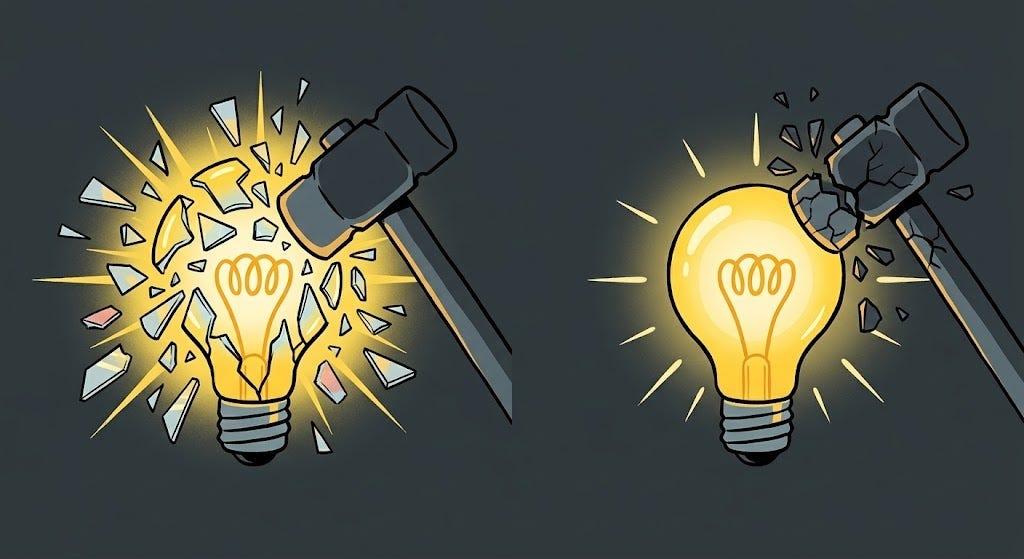
Learning can feel like dying.
It explains the idea of growing pains. Humans have an innate ability to let their ideas die instead of themselves. But that typically is accompanied by a fair share of discomfort.
Any new insight requires that we sacrifice our previous view of the world.
Learning is not purely about gaining new knowledge.
When a person acquires new information, they must typically forfeit something old. Maybe they must let go of wrong preconceptions or admit to former gaps in their knowledge. Either way, something previously present in their mind will disappear.
As the new comes in, the old goes out.
An all-too-human quality explains this.
One of our distinct abilities is to sacrifice our convictions instead of ourselves. Other animals, while learning, are more vulnerable to making fatal mistakes. We are somewhat special.
We can test ideas in the realm of thought, rather than reality itself. That allows us to figure out what works and what does not without risking serious harm.
The more cautious among us entertain false beliefs, test them, see them fail, and then try again unscathed.
Being proven wrong can hurt sometimes.
It just hurts in a different way.
Some beliefs are held lightly. It costs us little to let go of them. Other beliefs, however, are load-bearing.
It may occur that we tie our identity itself to something we believe. A romantic may believe his muse returns his affections; a scientist may stake his career on a hypothesis; and a Communist may believe his revolution will soon redeem him.
Such beliefs, when refuted, feel like emotional death.
In this case, convictions have become entangled with meaning, purpose, or identity. When heavily invested-in beliefs are dispelled, the experience is not mere correction. It can imply the end of one’s sense of meaning.
In this predicament, a person is forced to not only let go of a belief, but also of the identity it sustained.
Attachment to thoughts can be that intense.
The mind has a tendency to control reality, instead of letting it be. Dogmatic beliefs are instruments of this impulse. They reduce uncertainty, and thus anxiety, but at the cost of a connection to actual reality.
Because we cling to our beliefs, we do not accept corrective feedback. We prefer unreliable answers over no answers.
It is how we manage discomfort.
Sometimes, unfortunately, our core beliefs must die.
Then, our shield against reality falls away. Once again, we are exposed to the discomforts of the real world. With our reconnection to reality comes a reconnection to the reality of danger.
We become aware of threats to our lives, and hence our mortality.
It can feel as if the danger lies in the death of our ideas. But that is wrong. If we are to last ourselves, our ideas will have to die from time to time.
To survive, we must discard any wrong worldview.
It is somewhat paradoxical.
We make wrong assumptions to protect ourselves against feelings of vulnerability. If we never revise those assumptions, we continue acting on false premises. That may very well get us killed.
So the thing that feels like death is often what saves us.
From an adaptive point of view, it is favorable that part of us dies, rather than all of us. The death of an idea stings, but it is a controlled sacrifice. That prevents a final one.
Hence, a well-adjusted human being is engaged in a constant process of selective dying.
Lightly held beliefs can be released without serious cost. Beliefs at the core of our being, however, are different. And refuting them proves far more destructive.
Ideas should be shed the way we shed skin. When assumptions are only clung to on the surface, they are easily discarded - and revised.
Living true to that principle makes the pain of trial and error manageable, rather than catastrophic.
To grow, we must die.
But we must also choose what parts of ourselves survive.
Greater understanding implies the death of old beliefs. That we cannot control. But we can control whether that fact enriches life or ends it.
By accepting dying as a precondition for growth, we can keep correcting our direction; and that might very well be what saves us in the end.