


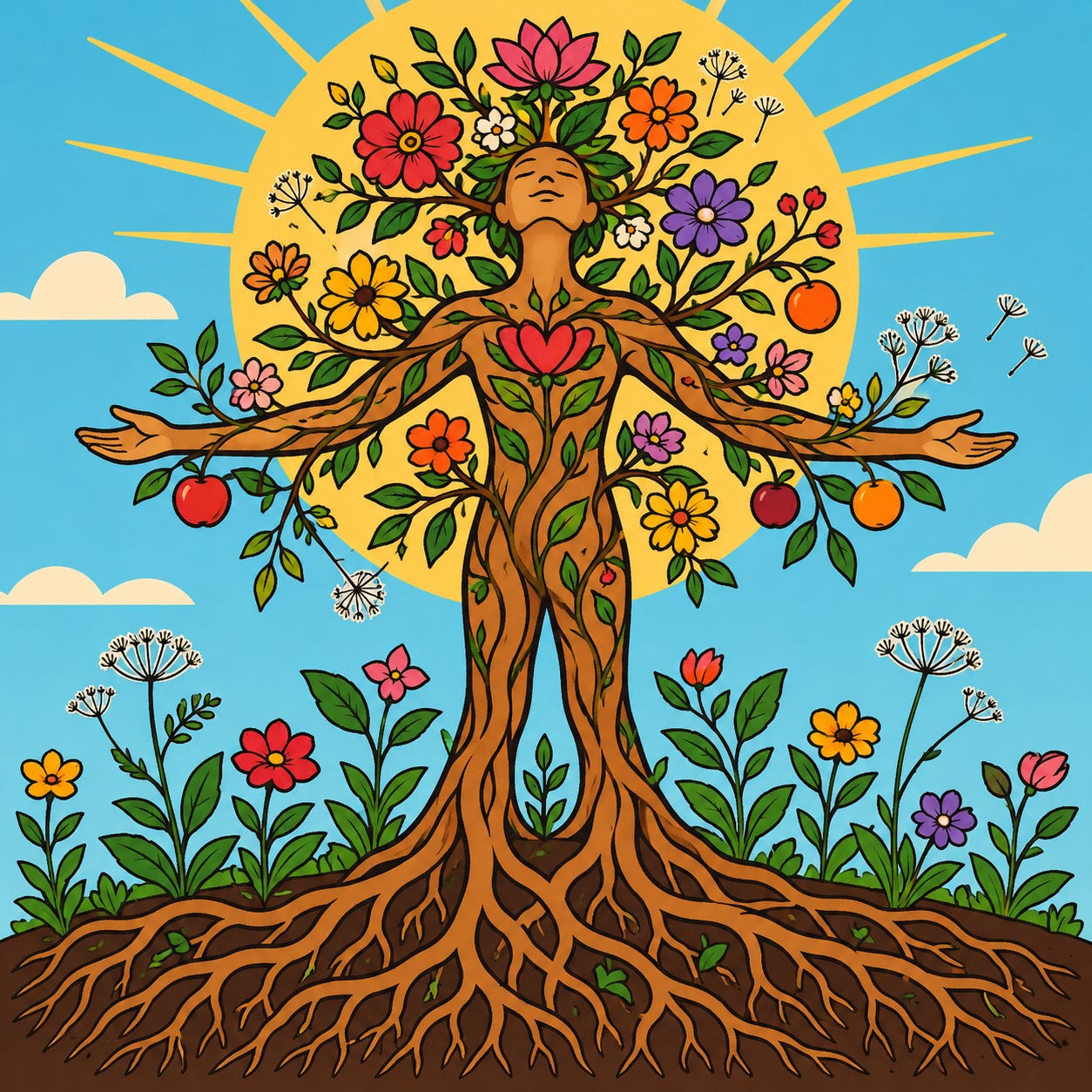
Human flourishing, they say, is something worth aiming for.
In itself, that sounds appealing. It certainly is good to have your cup consistently running over. Whatever you have extra, you can share with others.
Having much and sharing it leaves a person happy. That is desirable.
But what do we need to flourish?
A thriving organism generates more energy than it needs.
Take plants as an example. Botanical life forms grow flowers, fruits, and seeds wherever they prosper. Our word - flourishing - has the same root as flowering.
So how do we humans flower?
Since we are a little more complex than plants, what we bring to the table takes many shapes.
Imagine a homemaker who sustains a happy family. A pillar of the community, she is widely appreciated. People regard her positively wherever she goes, and she spreads positivity whenever she can.
Such a person wins no bread, yet it is accurate to describe her as someone who is thriving. The fruits of her labour are plentiful, but they do not show up on a spreadsheet.
Even if not strictly economic, anyone can deliver value to others.
When humans prosper, it leads to abundance.
This is true on both the collective and the individual level.
Abundance, in turn, can be provided to those in need. And if you want to sustain flourishing, you must fulfil need. Because need and abundance find it difficult to coexist.
You cannot thrive while desperately hungry.
Peace is another minimal condition for flourishing.
To thrive, you must be free of intrusions. Anything abrasive, whether it is inner voices, outer conflict, or actual violence, keeps you from your bliss. Such forces burden you until dealt with.
So long as threats demand your attention, you are focused on not falling prey to them. While busy not being depleted, it is difficult to focus on growth.
Prosperity requires peace.
Beyond peace, you need minimal resources.
The botanical conditions for blossoming are intake exceeding maintenance costs. A plant, among other things, requires light, water, and nutrients. There is a human version of the same phenomenon.
We, among other things, need food, rest, and connection. The latter is somewhat unique to us, although not entirely.
The point is that a material baseline exists for thriving to occur.
Organisms must be kept safe and out of chronic deficit. Only then can whatever surplus they have begin to snowball. Mess with either, and it stops.
The cycle is virtuous, but fragile.
There are conditions to be kept.
When they are, an organism (slowly) transitions from scarcity into abundance.
Botanically, photosynthesis begins to exceed the costs of repair and maintenance. The difference is allocated to new growth and, in season, to reproduction. Flowers and fruits begin to emerge.
Human beings, once again, display similar qualities.
Leftover time and energy allow for all activities that yield no immediate returns. If we choose them well, we grow more formidable. Deep learning does not put food on the table, but its value compounds if sustained.
The content varies across cultures, but the pattern is consistent.
When thriving, it becomes a possibility to initiate rather than merely react to life. Societies bear more fruit. Cultures grow more refined.
This is how flourishing translates to the civilizational scale.
When a population moves from insecurity to prosperity, attention frees up for improvement rather than mere survival. Individuals have spare time to better the world around them. Then, civilization begins to bloom.
A thriving society is more complex than a garden, but it flourishes on the same principles
This cycle of enrichment is as stable as its foundation.
Peace and freedom from need must still be secured. When things get too good, it can cause hubris or naivety. In bliss, people tend to fall blind to the prospect of disaster.
Still, prosperity is easily undone.
If peace and basic material well-being are not guaranteed, the flourishing will prove itself temporary.
Plants deal with a similar risk. Heavy fruiting can exhaust soil nutrients or reserves. Bearing too many fruits may attract predation.
Thriving depends on a balance, and it must be maintained.
Sustaining human flourishing is hard, yet simple.
There must be peace, or in other words, an absence of imminent danger. And there must be basic provisions, preventing chronic deficit. Then, flourishing can consistently produce a surplus which, if invested wisely, snowballs.
Life wants to grow, but you must let it.