


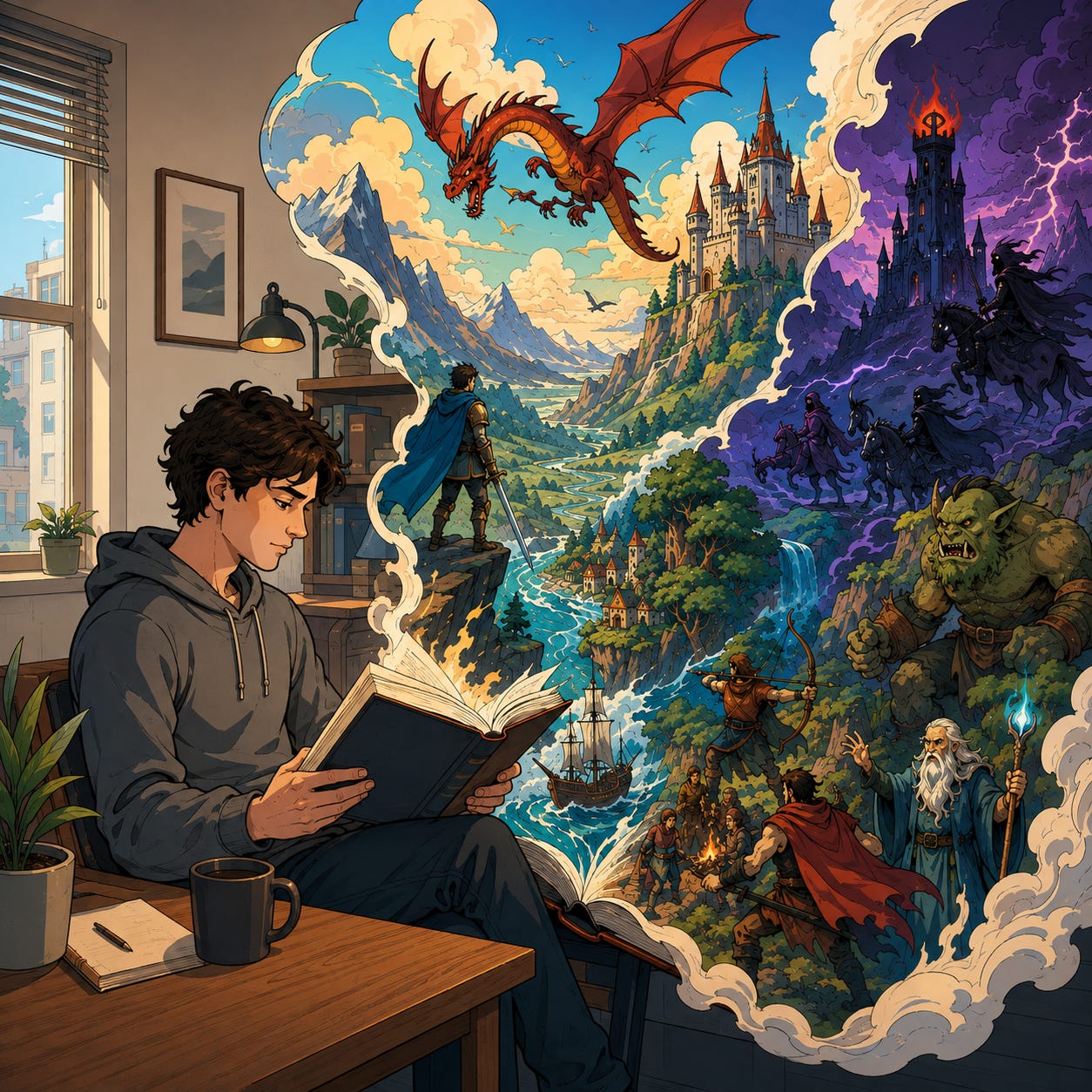
Great stories have a gravitational pull.
They compel us to listen, and often teach us something new. The best tales are known to provide two things: entertainment and a good lesson. Those two appear intertwined.
The best stories tend to make us wiser; why is that?
Relatability explains a part of it.
When you recognize yourself in a character, imaginary events begin to feel relevant to you personally. Suddenly, you relate to slaying monsters, casting spells, or exploring faraway lands. But that is not the only reason fiction can be so gripping.
Emotional stakes can spark curiosity like nothing else. They make us ache to know whether the story will end well or in ruin.
It begins to feel as if when characters win, so do we.
Our investment in fiction allows for its moral to be transmitted.
Preachiness is direct, but unelegant. Delivering a sermon works in church, not on stage. When a story paints human nature vividly, moral lessons naturally bubble up instead.
Without making it explicit, it will tell you something about choice and consequence. When you can show, there is no need to tell.
The most beautiful lessons speak for themselves.
Audiences, when free to, will always draw their own conclusion - so you might as well play into it. Fiction’s most powerful truths are rarely delivered by command. More often, they surface through implied wisdom.
If you accurately portray how people act, you will inevitably portray how they act in accordance with their own well-being.
Stories somehow fuse reality and imagination.
Narrative structure (character, conflict, development) bridges both. The best stories are fictional, but they accurately dramatize a concrete blueprint of human nature. They combine a would-be with an is.
We write “there once was…”, while there never was (and yet there is!)
Imagination - both in the creator and the recipient - is to a story what fuel is to an engine. Paradoxically, the more what you imagine squares with reality (heroism, struggle, triumph…), the more people will relate to it. Stories provide a distilled version of what life is actually like.
They are a shortcut to intense living.
By telling stories, we simulate lived realities. The stories are not real, but their structures resemble how our world works. The wisdom of the best stories applies to reality.
They are simultaneously real and not real.
Plus, it is strategically advantageous to rehearse reality. A fictional tale allows you to extract its wisdom without suffering the pain of trial and error. It is low-cost, high-reward.
This is how inspiration leads to self-actualization.
Stories illuminate the extraordinary. But by doing so, they provide us with something to carry back into ordinary life. They bridge the ineffable and the everyday.
Wonder is immediate, yet hard to define; that is why stories feel like magic.
Fiction entertains and enriches.
The good ones are the ones we want to listen to. When we want to listen, we remember what we were taught. For the best fiction, enjoyment and learning are not rivals, but twin effects.
No great societies have not told stories. Imagination is at the foundation of dreaming: wishing to achieve great things.
At a low price, the tales we tell provide all we need.