


Socialism, since its inception, has been the subject of fiery debate.
Some argue it is the only just political system. Others say it is inherently totalitarian. Throughout history, the socialist impulse has taken many different forms.
What we know: socialism has crossed the line many times, producing catastrophe. But the question remains when it moves from arguable naivety to disaster.
It is worth examining.
The term socialism emerged in the early 19th century.
Conceptually, however, it is much older.
In his book Utopia (1516), Thomas More provides an early literary vision of it. The book describes an island society in which property rights are abolished. King Utopus, the founder of Utopia, has decreed the end of private property; its citizens share all of their possessions.
Utopus’ design existed, according to the book, to eliminate greed, inequality, and conflict.
Although fictitious, this is an early account of socialism.
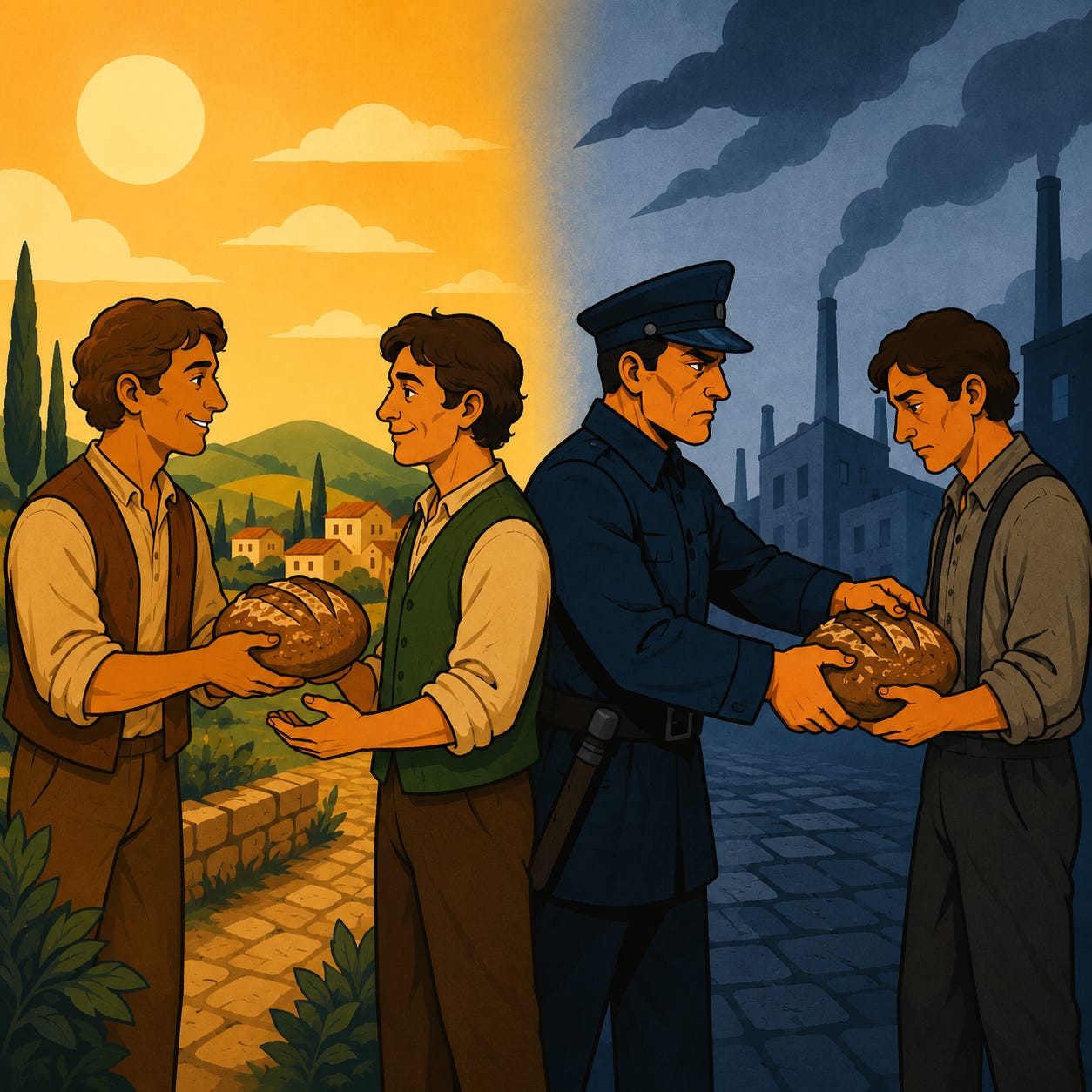
One might argue that socialism, as an idea, may be pursued in two ways: with the voluntary agreement of its subjects, and without it. People might choose to share goods because they want to, in which case we can accurately describe it as bottom-up. Otherwise, people are forced to do so.
In the latter case, it is inherently coercive: top-down.
Historically, there have been examples of bottom-up socialism.
Some socialist societies of the past relied on voluntary participation. By doing so, they self-selected for true believers: those eager to participate. Others were free to leave.
The kibbutzes in Israel are an example hereof.
They had success, although modest. But they relied on deep, shared values. And because they remained small-scale, they remained manageable.
Voluntary commitment was key to their results.
Coercive socialism is fundamentally different.
Since it must ensure equal distribution, it must enforce centralized economic planning. The justification given by those in charge is need. Drastic action, supposedly, is required to make a dire situation better quickly.
In practice, things rarely get better.
Coercive socialism requires abolishing (or at least severely restricting) property rights. As a result, incentives for wealth production plummet. Shortly thereafter, widespread poverty ensues.
Historical outcomes often included massive stagnation. That, in turn, causes widespread human suffering.
Citizens, then, are not only no longer free; their stomachs are empty as ever.
Bottom-up socialism can work, but it remains paradoxical.
Ironically, the socialist societies that were (somewhat) functional respected individuals: their right to keep their private property, and leave.
Bottom-up socialism, as far as it existed, did just that. It allowed others to contribute if they wished. Those who did not wish to be part of the project were not involved.
Coercive socialism, on the other hand, fully denies the right to refuse. It imposes collective ownership through force on a group of individuals who may not be eager to live as such.
The first allows people to share, the other demands it.
It may be concluded that socialism, if vaguely defensible, has regard for consent: the individual's wish to align with the cause.
In More’s book, the abolition of private property was a top-down decision. King Utopus decided for the people. So it did not emerge purely from voluntary agreement.
Even in the first Utopia ever conceived, it seems, socialism had to be imposed; that should tell us something.
The voluntary forms of socialism tended to remain small-scale. They self-selected for those committed to the cause. Large-scale attempts, almost exclusively, have required coercion.
The “functional” socialist communities succeeded largely not because they denied property rights; they succeeded because they respected them. No one was coerced into living in a way they did not wish to.
Although perhaps softer, this approach ensured those who did stay were actual believers.
To succeed, if ever, socialism should remain social.
History shows that, whenever vaguely successful, it is grounded in the consent of its participants.
It has proven itself modestly viable in limited contexts. Larger socialist projects, which rely on coercion, rarely have - if ever. Aside from crossing a moral line, they typically produce economic disaster.
At least partially, that is because it involves individuals who do not want to be involved. To remain prosocial, the socialist must remain cooperative.
Choosing to use force instead would make him, ironically, anti-social.