


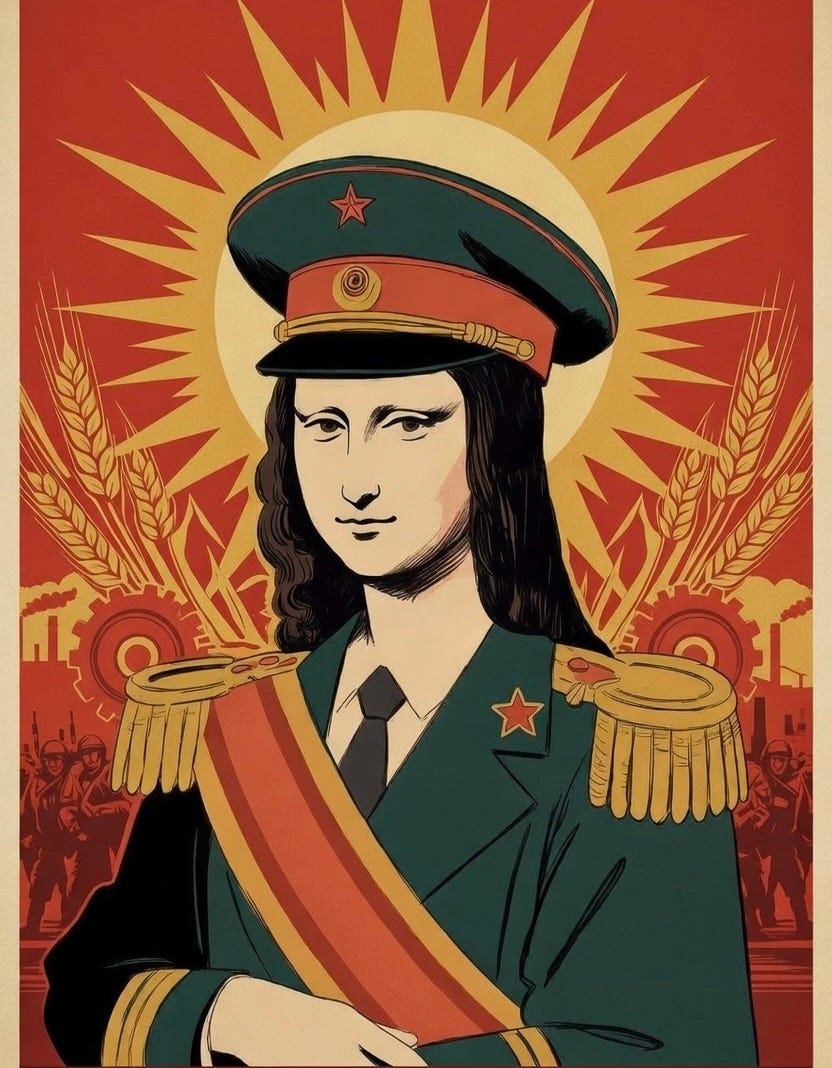
Sometimes, art and politics intermingle.
But when politics defines art, it typically dies. Modern art is rife with political messaging. Sadly, injecting ideology into creative work often undoes it.
Can art survive politicization?
True art sometimes engages the political.
When it is political at its core, however, it soon ceases to be art. Its essence is beauty. That is not optional.
Art is subject to judgment because of that. People either deem something beautiful or they do not.
Whether they do signals that the work has earned its place.
Hence, art is fundamentally different from politics.
Creating something beautiful is terribly difficult. To achieve it, the artist must self-improve endlessly and subject himself to judgment. That requires humility: admitting your shortcomings.
Politicians typically lack such humility. If they did not, they would lack the determination needed to realize their ambitions.
Politics typically requires certainty, and art requires doubt.
These two approaches can rarely coexist - if ever.
That does not keep politicians from infringing upon the artistic domain. They seek to recruit art to their purposes. But beauty is unlikely to serve anything but itself.
Art produces beauty. Politics preserves power.
The former appreciates the world; the latter seeks to change it.
Hence, politics often leads to art’s demise.
It subordinates beauty to the message. Therefore, it sacrifices art to ambition. Aesthetics becomes a delivery vehicle for ideology.
It does not allow the good and true to define itself. It only allows the politically correct.
In this standard lies the danger.
Once political alignment is a precondition for creative work, art loses its ability to push boundaries. What should be wild is now leashed. And ultimately strangled.
What survives - wearing its skin - is the ideology.
To the artist, politics can be attractive.
Honing a craft is an arduous process. Political belonging, on the other hand, just requires saying the right thing at the right time. Achieving excellence is difficult; being a puppet is not.
But if you become one, you lose your authenticity, and therefore your capacity for beauty. This is the artistic trap.
The “safe” path will lead the artist astray.
To master his craft, he must submit to beauty itself. Ideologues, instead, submit only to their own approval. And such approval, if earned, covers even artistic failure.
Although ideologues can rarely be artists, they can still pretend.
It provides would-be artists with a certain protection. It is how they bypass the grind towards mastery. Political grandstanding delivers the immediate approval that slow growth never could.
Still, the artist’s longing remains unfulfilled.
It is hard to stay true.
But it is what separates the wheat from the chaff. Trying implies the possibility of failure. The artist’s vision, if unique, will be misunderstood - at least at first.
Falling prey to politics instead means sacrificing his essence.
To be an artist, he must risk being so.
Achieving beauty demands risk. And politicians minimize risk: for the sake of keeping power. Even if it kills beauty.
The artist, instead, protects beauty with his life.